Written by Onthatile Morulane
The PSETA–UJ Research Observatory and Skills Compendium were presented to the SAAPAM community as tools to connect research with public administration practice.
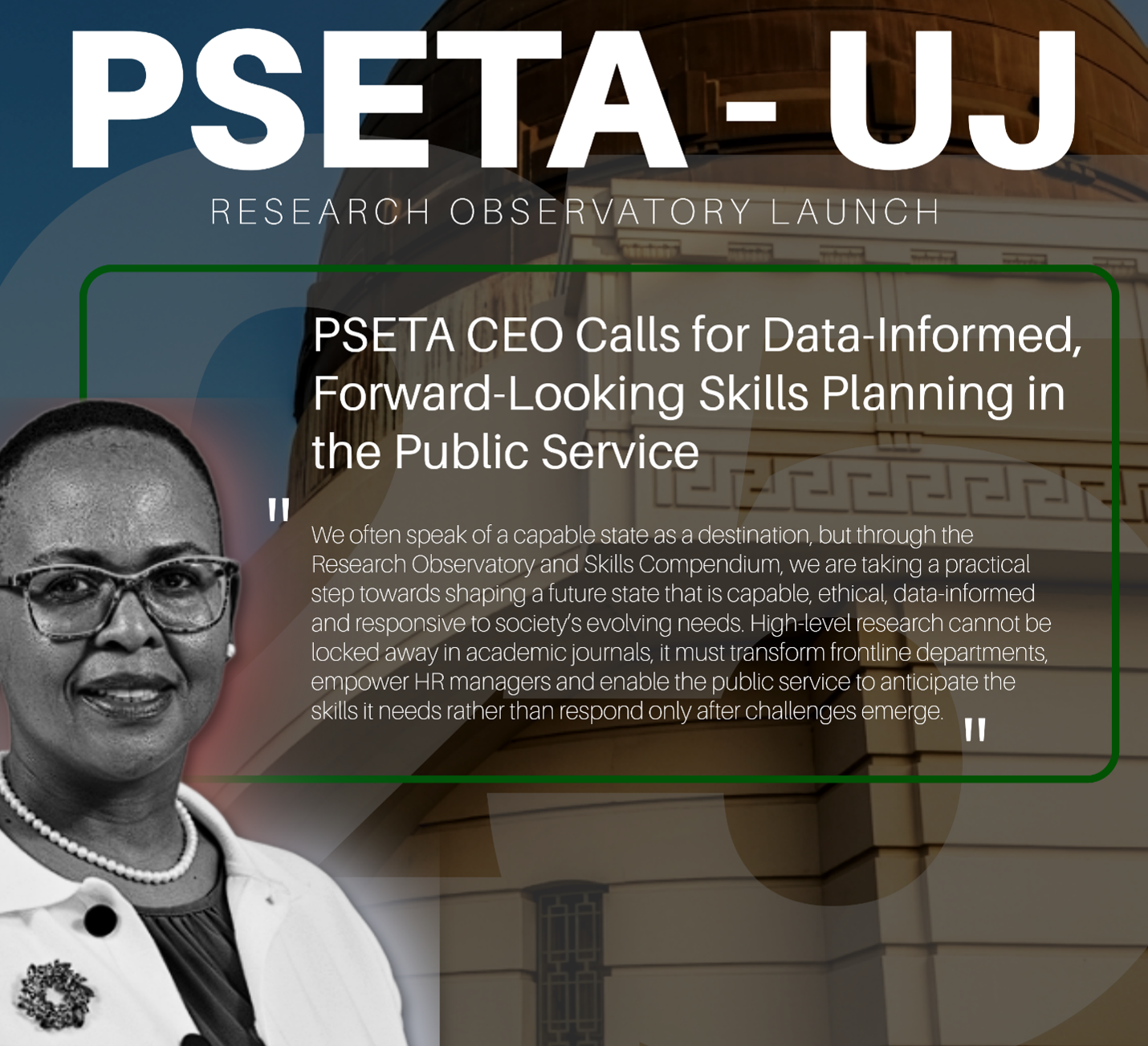
Bontle Lerumo, Chief Executive Officer of the Public Service Sector Education and Training Authority (PSETA), has called for a more coordinated, predictive and practical approach to skills planning in the public service. Addressing a session hosted for the SAAPAM community, she introduced the PSETA–UJ Research Observatory and Skills Compendium as instruments for building a capable, ethical and responsive state.
The session demonstrated both tools, which are intended to link academic research with the realities of public administration. Lerumo described the initiative as a deliberate strategic intervention, informed by systemic challenges identified through research conducted in the sector.
Lerumo pointed to the fragmentation of data and the number of role players operating across the skills-planning environment, as a persistent obstacle. She also raised concern about compliance-driven planning, in which workplace skills plans are submitted to satisfy requirements rather than to advance meaningful institutional development.
The initiative seeks to shift that mindset. Institutions are encouraged to treat skills planning as a practical tool for identifying and addressing future workforce needs, anticipating change rather than responding only once challenges have emerged.
A central objective of the Research Observatory is to improve the sector’s ability to forecast future skills requirements. Lerumo observed that institutions frequently respond only after major changes, such as mergers, have already taken place. The Observatory is designed to support a more forward-looking approach, helping stakeholders identify the skills and capabilities the public service will need.
This predictive focus is expected to support better decision-making and stronger alignment between institutional priorities and workforce development strategies.
Lerumo stressed that skills planning, implementation and departmental capacity must be aligned, and that institutions working in isolation cannot deliver a coherent outcome. Through the PSETA–UJ collaboration, the Observatory is expected to inform an annual report on the state of skills in the public service. Drawing on data available through the Observatory, the report will give stakeholders a clearer picture of skills trends and capacity needs.
The Skills Compendium was presented as the practical counterpart to this research effort. It combines high-level labour-market analysis with sector occupational frameworks in an accessible, interactive digital resource.
It is intended for policymakers, academics, administrators and human-resources managers, offering operational guidance for skills planning and implementation. Lerumo emphasised that research should not remain confined to academic journals but should contribute directly to the work of frontline departments and those responsible for managing human resources.
The session included a live demonstration of the Observatory’s architecture and functionality. Participants were invited to share insights, critical reflections and feedback to help refine the Compendium and ensure it meets the needs of the public service.
The launch reflects a broader effort to bring research, data and practice together in support of more effective public-sector planning. By strengthening cooperation among institutions and improving access to relevant information, the initiative aims to contribute to a public service that is better prepared, more responsive and better able to meet society’s evolving needs.
How can we help you?
One Response
This is a great initiative towards building a more capable, ethical and responsive public service. Skills planning should go beyond compliance and focus on preparing institutions for future challenges. Bridging the gap between research and practice is essential for effective public administration and improved service delivery. 👏🏽