Written by Onthatile Morulane
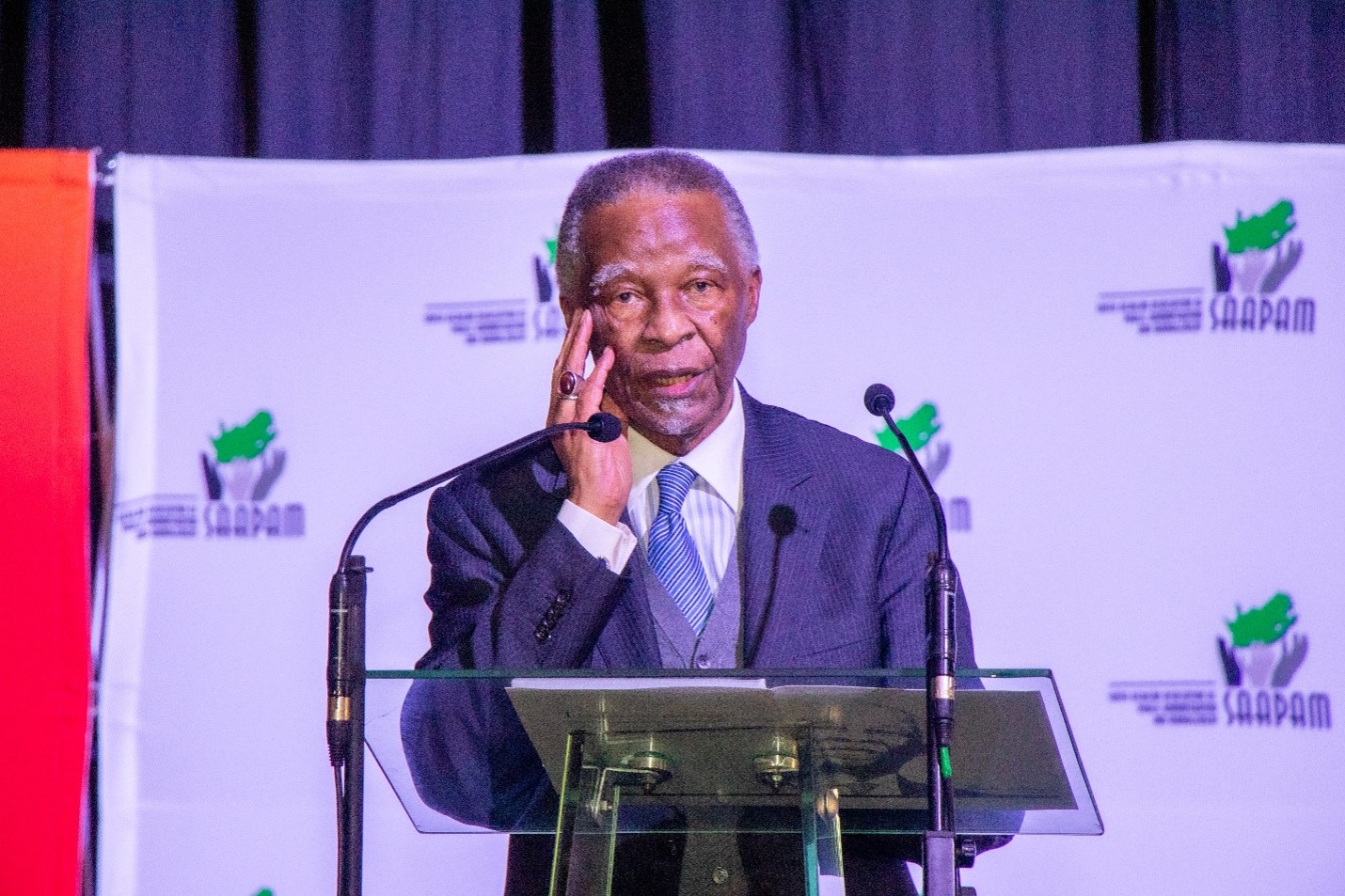
Awards dinners usually end with applause and a clean exit. At the 25th SAAPAM Annual Conference Gala Dinner in Durban, Dr Thabo Mbeki had other plans.
He had come to receive the Distinguished Public Service Award and he began lightly. When he asked how long an acceptance speech should be, he said, the answer was “as long as you want.” The printed programme had given him fifty minutes. He suggested it should have said until nine. Laughter rolled through the hall and then he turned to the brief SAAPAM had handed him: reflect on public service, governance, development and the future of South Africa.
He started with an old argument. There was a time, he reminded the room, when the Washington Consensus held that the best state was a minimal one and President Reagan’s verdict that the state itself was the problem became the mood of an era. The World Bank’s 1997 report pushed back with the evidence. State-dominated development had failed, but so had stateless development and the people of collapsed states like Liberia and Somalia had paid for that lesson. Good government, the report argued, was a vital necessity, not a luxury. Mbeki called the idea of the state as partner, catalyst and facilitator “a debatable point” but he held that the framework was right.
Then he set that theory beside the country outside the ICC’s doors.
A more recent analysis, he said, describes South Africa as an “emasculated state”: one whose ambitions keep growing in the form of new laws, grand schemes, smart cities and bullet trains, while its ability to deliver quietly shrinks. Everyone in the room knew the evidence. Those who can afford it have left public healthcare and schooling behind. They put solar panels on their roofs because the national utility cannot be trusted to keep the lights on. In the unrest of 2021, citizens stood guard over their own property while the police and army were conspicuous by their absence. Residents’ associations repair the roads, farmers mend the water infrastructure and large companies secure the freight corridors.
“Not incorrect,” Mbeki said of the description. Where he parted ways with the analysis was its conclusion. The author saw in all this South Africa’s great opportunity, a lean state cooperating with a resilient private sector and civil society. Mbeki heard a warning instead. A street can fill its own potholes but it cannot end poverty.
South Africa, he reminded his audience, has already chosen a different path: a capable, ethical, developmental state, a goal that even the Government of National Unity endorses. But he wanted to know what the words mean. Capable of what? What does an ethical state look like? And such a state needs people to staff it, so did South Africa have them and how would it produce them?
He turned the question on his own movement. Nelson Mandela had said in 1997 that the ANC, once it governed, attracted people who saw it as a path to power and self-enrichment. Everyone agreed it was a correct observation, Mbeki said and then nobody knew what to do. Twelve rand bought a membership card, and nobody declares their motives at the door. Left unchecked, a thousand such members become two thousand, then ten thousand, until they change the nature of the organisation. The ANC is so dominant, its failings “seep into the rest of society,” the public service included.
Then he brought it down to practice. A developmental state needs real clout in the economy, not only speeches and regulations. Yet, in his view, the creeping privatisation of state-owned enterprises, with sections of Transnet being hived off, is weakening the state’s capacity even as the rhetoric of the developmental state grows louder. He asked if anyone in the GNU could name five or six concrete steps taken since 2024. They could not, he said, because nothing has been done.
The cost of that failure, he warned, will be measured in poverty. The private sector will not eradicate it. Without a capable, effective, ethical and developmental state, poverty will deepen, frustration among ordinary people will grow and “in the end there will be a big explosion.”
Then came the part the host institution may have least expected. SAAPAM, he said, does valuable research on what works and what does not. But he had not heard it say publicly what is really happening to the democratic state. It should ask out loud whether South Africa is building an emasculated state and what must be done to reverse it. He looked to the Public Service Commission, whose chairperson was in the room, and asked where its voice was, since it deals with these questions every day, saying that the country speaks of a developmental state while walking the opposite way. He asked the same of the public-sector trade unions: beyond wages and conditions, where is their voice asking what has happened to the state?
Political parties, he suggested, will not provide the answer. The answer has to come from the people, who hold the sovereign right to decide their own destiny. They should sit together in a national dialogue and say which South Africa they want and which they do not.
It was an acceptance speech that ended with an assignment. Twenty-five years after its founding, SAAPAM left its Silver Jubilee with an award for a former president and a question for itself, and for every institution in the room: if not you, then who?
How can we help you?