Written by: Onthatile Morulane
Vil-Nkomo Lecture opens the Silver Jubilee conversation on knowledge, democracy and the humanisation of the state
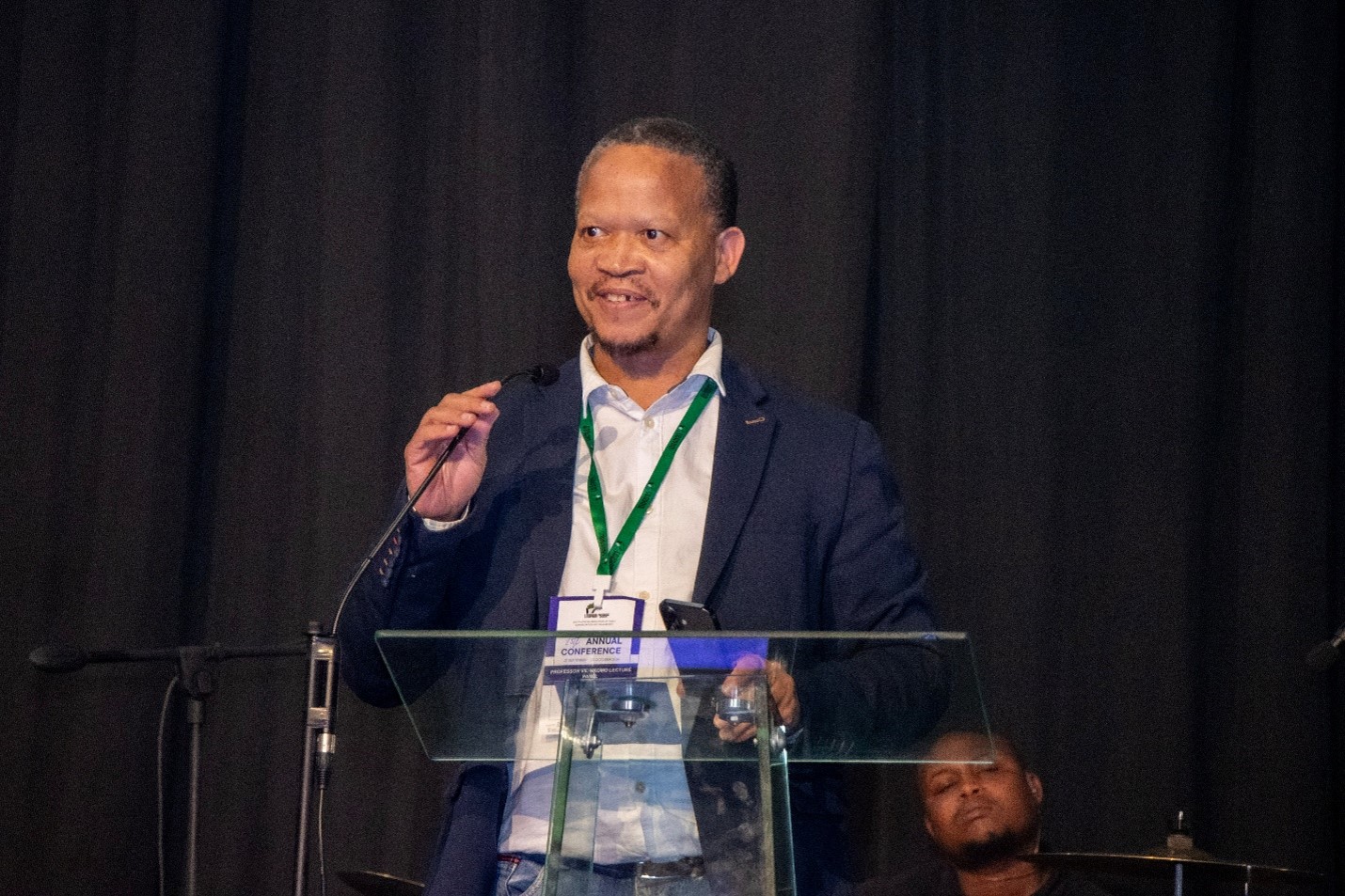
A state can run flawlessly and still fail its people. That uncomfortable idea sat at the centre of the Vil-Nkomo Lecture delivered by Prof Maserumule, Executive Dean at the Tshwane University of Technology (TUT), at the 25th Annual Conference of the South African Association of Public Administration and Management (SAAPAM).
Rather than offering delegates a tidy set of administrative prescriptions, Prof Maserumule opened with a question: how does the state know what it knows and who decides what is right or wrong?
He argued that the question is not abstract. It sits underneath every budget, policy and service-delivery decision and it is inseparable from the study and practice of public administration.
Prof Maserumule pushed back against the idea that administration is a neutral, mechanical instrument for carrying out policy. Systems built only on rules, procedures and measurable outcomes, he suggested, miss the human and political forces that shape how government actually works.
Public administration, in his account, does not operate in a vacuum. It is embedded in communities whose needs and expectations influence how policies are designed and delivered. It is shaped by history, values and competing readings of reality. Efficiency has to be connected to justice and citizens and communities have a role in shaping the institutions that serve them.
Tracing the discipline through religious and liberal thought, the founding of universities and institutions, and the rise of positivist, modernist and postmodernist schools, he noted that each tradition carries its own assumptions. The question that matters, he said, is not which theory is correct but what each one shapes: what gets measured, which voices are heard, what counts as evidence and how a public problem is defined.
One of the lecture’s most striking turns was its treatment of bureaucracy. The classic picture is of a rational, ordered machine in which officials perform defined functions within a hierarchy. Prof Maserumule drew on the insight that bureaucracy is also humanised. Its institutions are made of people and their decisions land on people. Officials interpret rules and exercise discretion. Citizens meet the state through those encounters.
A humanised administration, he argued, demands more than technical competence. It requires ethical awareness, social responsibility and a real understanding of the lived realities of those being served. It must also stay connected to the public and be judged on its fairness and accessibility as well as its speed.
The lecture’s sharpest warning came in a phrase that lingered with delegates: “efficient exclusion.” Prof Maserumule described the danger of a system that is efficient yet anti-democratic, one that completes its procedures successfully while shutting out certain communities, perspectives or forms of knowledge.
An institution can meet every stated objective and still produce unjust outcomes if it ignores equality, representation, dignity, participation and historical disadvantage. Performance, he argued, cannot be measured by speed, cost reduction or compliance alone.
The point extends to knowledge itself. Governments lean on official data, technical reports and expert opinion, which are valuable but not the only ways of knowing. Facts, protocols, images, politics and texts cannot be neatly separated, he said and the meaning given to a fact depends on who produced it and where. He asked whose knowledge the state recognises, whose experience is left out of official accounts and who decides what counts as valid evidence.
In societies marked by racial, social and economic inequality, the implication is serious. If a state’s underlying knowledge systems stay the same, democratic elections alone may not transform the quality of governance.
Prof Maserumule acknowledged the periodic declarations of the “death” of public administration, which tend to surface when the field seems remote from citizens or unable to answer political and social realities. His response was renewal, not retreat. He called for a practice that is rational without being reductionist, efficient without being exclusionary, and democratic without becoming ineffective. It should also stay grounded in lived experience and institutional responsibility.
He also urged a closer bond between theory and practice. Scholars, he said, should take on real public-sector problems, while practitioners should engage critically with research rather than treating routine as beyond question. Dialogue among universities, government and communities, together with practical training and evidence-based policy, could help close the gap.
Prof Maserumule closed by separating formal democracy from substantive democracy. Free and fair elections are essential, he said but they do not automatically improve governance or people’s lives. A society can win political freedom and still carry forward institutional habits that reproduce exclusion.
He left delegates with a challenge for the week ahead, a conference marking SAAPAM’s Silver Jubilee: to ask whether democracy has changed how the state understands society, defines problems, designs policy, delivers services and pursues justice.
The question he returned to at the end was the one he began with: how can the state know what it knows and how can that knowledge become public action that serves all people fairly?
How can we help you?